

Prospects of Pakistani rice: a global perspective
by Karim Ali
BEIJING, May 10 (CPAIC)-A detailed report on Pakistani rice was released on the China-Pakistan Agricultural and Industrial Information Platform (CPAIC) today, which offers a comprehensive overview of the varieties, production, trade, and prospects of Pakistani rice.
According to the report, while Pakistan has already become one of the top rice producers and exporters in the world, there are still abundant opportunities to be exploited in the international market.
Pakistan: major rice producer & exporter
Pakistan is among the top rice producers and exporters in the world. According to data of the Food and Agriculture Organization (FAO), Pakistan provided over 10% of the world’s rice output and was ranked at the ninth position in 2019.

Top 10 Country Production of Rice, paddy 2019. Source: FAOSTAT
Rice is the sixth largest export commodity and the largest non-textile export commodity in Pakistan. According to data of the International Trading Center (ITC), Pakistan exported 4.59 million tons of rice in 2019, equivalent to USD 2.3 billion value-wise, both of which accounted for 10% of the world’s total exports, making Pakistan the third largest rice exporter in terms of both volume and value.
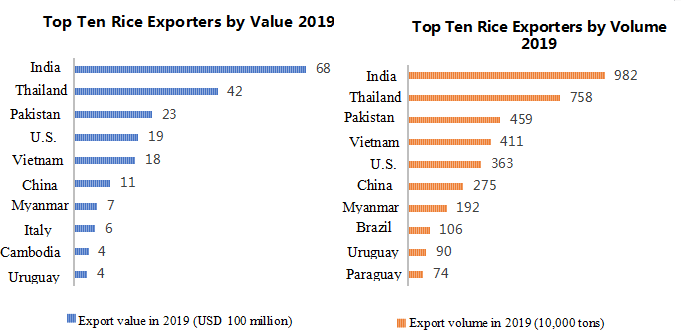
Top ten rice exporters 2019. Source: International Trading Center
The rice grown in Pakistan is mainly divided into Basmati rice and non-Basmati rice. Basmati rice, with slender and elongated grains, aromatic taste, and soft and fluffy texture when cooked, is one of the most favored high-end rice varieties in the international market. Pakistan is the most important growing area of Basmati rice besides India and Bangladesh. In Pakistan, Punjab is the main rice growing region, accounting for 65% of total rice cultivation area and 52% of total rice production. Meanwhile, Basmati rice takes up 52% of total rice area and 40% of total rice output in Pakistan.

Rice export volume of Pakistan 2010-2019. Source: PBS
Admittedly, challenges in terms of energy, quality, branding, financing and taxes are still yet to be tackled to enhance its competence in the international market, Pakistani rice has unparalleled advantages in cost and yield.
The average cost per acre of both Pakistan’s Basmati rice and IRRI rice was below PKR 50,000 in 2019 in accordance with calculations by the Agriculture Marketing Information Service (AMIS), Directorate of Agriculture Punjab, as listed in the 2020 Q1 report of Pakistan Bureau of Statistics. This was even lower than other major seasonal crops such as corn, cotton or sugarcane (around PKR 60,000 to 100,000 per acre). Therefore, rice cultivation boasts competitive edges in Pakistan, and its scale may be further expanded.
Hybrid rice breeding assisted by China is elevating Pakistani rice yield to a new height. Honglian hybrid rice developed by Wuhan University and harvested in 8 demonstrative plots in Pakistan has demonstrated ability to raise production by two times. A rice variety bred by China’s Yuan Longping High-tech Agriculture Co., Ltd. in collaboration with Guard Agriculture Research and Services are anticipated to double the rice production in Pakistan from 2 tons per acre to 4 tons per acre. Last year, a total of 500 tonnes of hybrid rice seeds from a seed company in east China's Jiangsu Province landed in Pakistan to help ensure the country's grain yield.
Export potential: a global perspective
Global demand for rice is still growing. Wherein, demand for ordinary rice in Africa and poorer regions of Asia is forecast up with population growth, while the more developed regions in Asia are anticipated to show interest in higher-end fragrant rice. Therefore, market is expected to further expand for both ordinary rice and Basmati rice exported by Pakistan.
As impacted by the Covid-19 epidemic, drought and other factors, the world’s major rice producers – China and Thailand – are expected to see production drop, which will drive up global rice prices. As a result, Pakistan is anticipated to both expand export volume and increase export price, thereby fetching higher export earnings.
In addition, as India adopted the lockdown policy under the influence of the Covid-19 pandemic, Pakistan may seize export markets occupied by Indian rice. Prior to that, when EU revised its regulations on the acceptable pesticide residue level in foods in 2018, the Background section of the report pointed out that Basmati rice produced in India contained high levels of tricyclazole (insecticide). This resulted in a decline in the market share of India’s Basmati rice.
China: an under-tapped market
China permitted imports of Pakistani rice in January 1, 2006. In February of the same year, the first batch of rice shipped from Pakistan arrived in China, achieving a historic breakthrough. Today, China is the third largest importer of Pakistan’s non-Basmati rice. In 2017-18 FY, China imported 267,000 tons of non-Basmati rice from Pakistan with a worth of USD 105 million. However, rice imports of China only accounted for 6.6% by volume and 5% by value in Pakistan’s total rice exports in 2017-18 FY. At the same time, rice imports from Pakistan only constitute a small proportion in China’s total rice imports, which may be because China’s rice imports mostly concentrate on low-priced non-Basmati rice. Based on customs statistics of China, rice shipments of Pakistan accounted for 11%-24% by volume and only 0.9%-1.8% by value in the total rice imports of China. Hence, there is great room for improvement as for Pakistan’s rice exports to China.

During the last four years, Pakistani rice exported to China has increased by 244%. According to the CPAIC report, with the deepening of China-Pakistan trade cooperation, Pakistan's rice exports to China are still expected to rise. The second phase of China-Pakistan Free Trade Agreement (FTA) officially entered into effect on January 1, 2020 and will last until 2024. Pakistan is actively working to expand its rice exports to China. According to a report on China-Pakistan Economic Corridor on January 9, 2020, Abdul Razak Dawood, Advisor to Prime Minister on Commerce, Textile, and Industry, has stated that Pakistan successfully achieved its quota of 250,000 tons rice export to China. The rice shipment was exported to China under the duty-free incentive package of USD 1 billion awarded by China to Pakistan to uplift its exports. He said China had granted Pakistan the opportunity to export an additional 500,000 tons of rice.