
Shakeel Ahmed Mangnejo appointed as PNSC board chairman
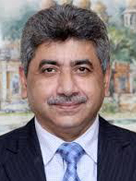
Shakeel Ahmed Mangnejo, Chairman, Pakistan National Shipping Corporation [Photo/PNSC]
ISLAMABAD, June 15 (Gwadar Pro) - In pursuance of Establishment Division notification issued on June 9, Shakeel Ahmed Mangnejo, presently posted as Director General (Ports and Shipping), Karachi under Maritime Affairs Division, is appointed the Board of Directors and Chairman Pakistan National Shipping Corporation (PNSC), for the unexpired term, till December 3, 2020.
Shakeel Ahmed Mangnejo is entrusted with the post of Director General (Ports and Shipping) for a period of three months or till the posting of a regular incumbent, whichever is earlier.
As per the notification, Rizwan Ahmed will cease to be the Director of BoD of PNSC and Chairman PNSC on the date Shakeel Ahmed Mangnejo takes charge as Director and Chairman, PNSC and the intervening period from August 22, 2019, till the relinquishment of charge or till the appointment of a regular incumbent, whichever is earlier, is regularized.
According to a report of Business Recorder, the post of Chairman PNSC has been vacant since April 1, 2019 after transfer and posting of Rizwan Ahmed, as Secretary, Ministry of Maritime Affairs (MoMA). The federal government entrusted additional charge of the post of Chairman PNSC on April 8, 2019 to Secretary MoMA as a stop-gap arrangement and subsequently, extended it till August 21, 2019.
Mangnejo is an officer of Pakistan Administrative Service. He joined Civil Services in 1996. Prior to the assignment, he has held the position of Chief Executive Officer of Pakistan Reinsurance Company Limited and also served as Home Secretary, Secretary Social Welfare, Secretary Implementation, Special Secretary Finance and Managing Director Public Procurement Regulatory Authority in the Government of Sindh. He has held the position of Director General Investment, EOBI and Director Finance, Trading Corporation of Pakistan in the Federal Government.
He has served on the boards of National Investment Trust, Pakistan Industrial Development Corporation, Pakistan Steel Fabricating Company, PRIMACO and Sahara Insurance Co. (subsidiary of EOBI).
Mr. Mangnejo is currently serving on the Board of Gwadar Port Authority.
Mangnejo has a Masters's degree in Management from the London School of Economics, UK, and a Masters degree in Economics. He also has a degree in Law and Civil Engineering. Mr. Mangnejo is a certified Director from the Pakistan Institute of Corporate Governance (PICG).
Headquartered in Karachi, PNSC is engaged in the transportation of dry bulk and liquid cargoes globally. It has been listed on the Karachi Stock Exchange (KSE) since 1980. PNSC is an autonomous corporation, which functions under the overall control of the Ministry of Maritime Affairs, Government of Pakistan. Managing a fleet of 11 ships, PNSC transports all types of cargoes on several geographical routes covering almost the entire world. It also holds business in real estate and owns a repair workshop.
According to PNSC’s 3rd quarterly report, despite macroeconomic challenges faced by the country as a result of lockdown due to prevailing coronavirus pandemic situation globally, PNSC Group has managed to achieve6% increased profit after tax of Rs 1,411 million as against Rs 1,332 million in the corresponding period last year. Group earnings per share increased to Rs 10.68 as against Rs 10.09 in the corresponding period last year.
Cumulatively, following the addition of two vessels in PNSC managed fleet, Group achieved a turnover of Rs 9,621 million (including Rs 1,135 million from PNSC) as compared to Rs 7,859 million (including Rs 1,959 million from PNSC) for the corresponding period last year.
This includes substantial growth in managed tankers segment revenue of 63% (from Rs 4,213 million to Rs 6,876 million) anddecreaseof 7% (from Rs 1,717 million to Rs 1,609 million) in bulk carrier segment.
However, PNSC standalone results reflected a loss after tax of Rs 779 million with a loss per share of Rs 5.90. The main reason is the significant decline in slot charter revenue and a ban on the import of furnace oil. This situation is further aggravated by the unprecedented global lockdown due toCovid-19pandemic that has also affected dry bulk market resulting an insignificant decline in BDI rates. Further, finance cost has increased from Rs 188 million to Rs 886 million due to increase in borrowing for acquisition of two LR-1 tankers and a significant increase in KIBOR.