
Seminar held in Islamabad to mark BRI 10-year anniversary
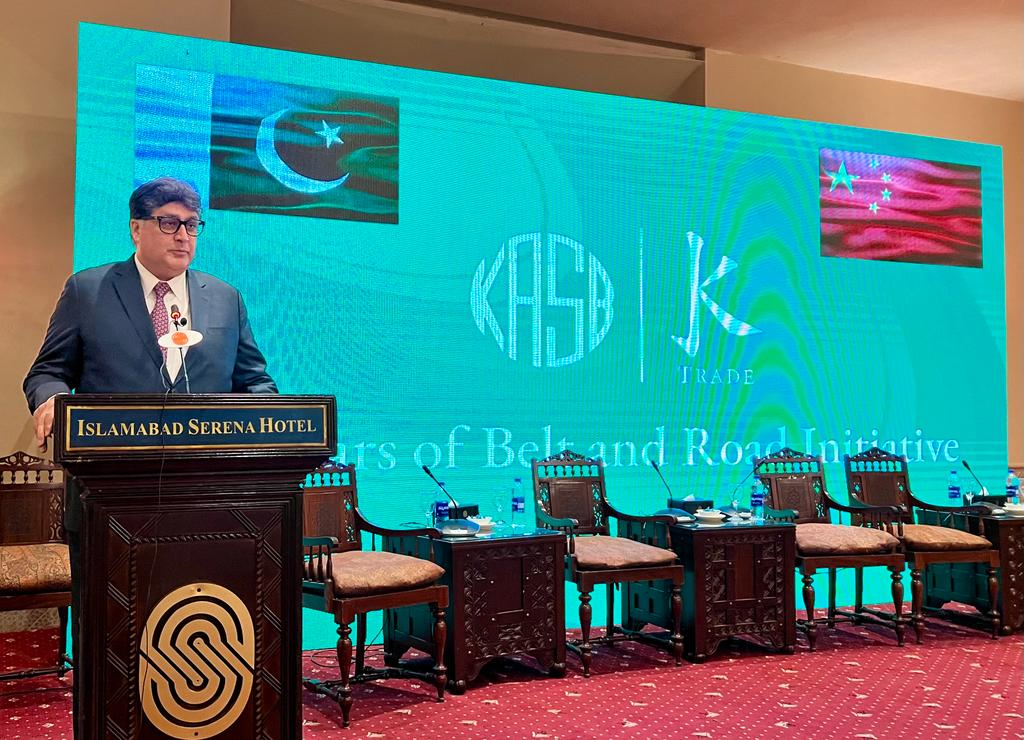
Minister for Privatization, Fawad Hasan Fawad, speaking at KASB’s BRI report-publishing event. [Photo by Tahir Ali]
ISLAMABAD, Oct. 13 (Gwadar Pro) - “What we need is ownership of the Pakistan-China relationship at all levels. And let us not only talk about the development side of this relationship, the Sino-Pak relationship is extremely critical for the peace in this region. This is my belief that the peace in this region is rooted in the cooperation between Pakistan and China,” affirmed Federal Minister for Privatization Fawad Hasan Fawad.
Fawad Hasan Fawad was the keynote speaker at an event hosted by KASB Trade Securities on Thursday to marking the “10 Years of the Belt and Road Initiative”.
According to the Minister, if someone was interested in contemplating the initiation of bureaucratic reform and enhancing the ease of doing business, taking China as a prime example is the ideal starting point. “We don’t need to reinvent; we can just pick up the model and can just see what it was done,” he said and added, “There will be some considerable context that we will need to address”.
Reflecting on the 10 years of CPEC, he noted that CPEC is a $62 billion project; by the time of the 1oth year, the total investment remained at $26 billion. “This is not due to the unavailability of the full $62 billion but because we did not have the capacity and the space or the bandwidth for implementation of only $62 billion. CPEC even has the capacity of an investment of $100 billion or $200 billion,” he said.
Nasir Ali Shah Bukhari, Chairman of KASB Group, said that Pakistani students who went to China are now making an impact, with around 1,000 Ph.D. students returning or in the process of returning. He emphasized, “That is our real wealth; that is our real growth story; they will contribute to Pakistan’s economy”.
During the first decade, Pakistan missed opportunities with CPEC by not establishing SEZs for Chinese investors. Now, with rising business costs in China, Pakistan is an attractive destination for their production relocation. He said that in the next stage, the focus should be on the integration of science and technology into Pakistan’s local industries.
China, a major producer of garments in the world, is actively discussing the establishment of full garment cities in Pakistan, specifically SEZs for garment manufacturing. “Our raw materials, their technology, financial support, and also their market available is a real success formula,” he said, adding that the ten years of CPEC has to be “private sector driven” and the government should make these SEZs a reality.
According to Mr. Bukhari, out of the 600,000 freelancers, only a few are currently engaged in business with China, despite it being the world’s largest IT market. Mr. Bukhari suggests that Pakistani freelancers should actively pursue opportunities in the Chinese market.
Nadia Ishtiaq, MD of Corporate Finance at KTrade Securities, presented a report that emphasized the positive impact of CPEC on Pakistan’s economy and its benefits across various sectors in the country, including energy, transport, Gwadar Port, Social Economy, Industrial Cooperation, and Trade.

Nadia Ishtiaq presenting KASB’s report on CPEC. [Photo/Tahir Ali]
As per the key highlights of the report, reliance has increased on local manufacturing amidst a surge in power generation as CPEC’s completed power projects account for 1/4th of the country’s power generation. The economic recovery is expected to be led by local CPEC projects, especially in the construction sector. CPEC Power plants provided cheaper electricity by utilizing Thar coal reserves, leading to a reduction in Pakistan’s oil and gas import bill burden. Textile exports have registered a 5-year CAGR of 9.1% between FY 17-22, and amidst the completion of other CPEC energy projects, exports are likely to grow at a similar upward trajectory. Structural reforms hold the key to materializing CPEC’s potential.
Panel discussions were convened on a range of topics encompassing agriculture, energy, and Information Technology. Distinguished panelists delved into the progress of Chinese enterprises in mobile and automobile manufacturing, as well as ongoing energy projects overseen by Chinese construction firms. Furthermore, they explored the current state of agricultural initiatives and prospects for future collaboration across various sectors.